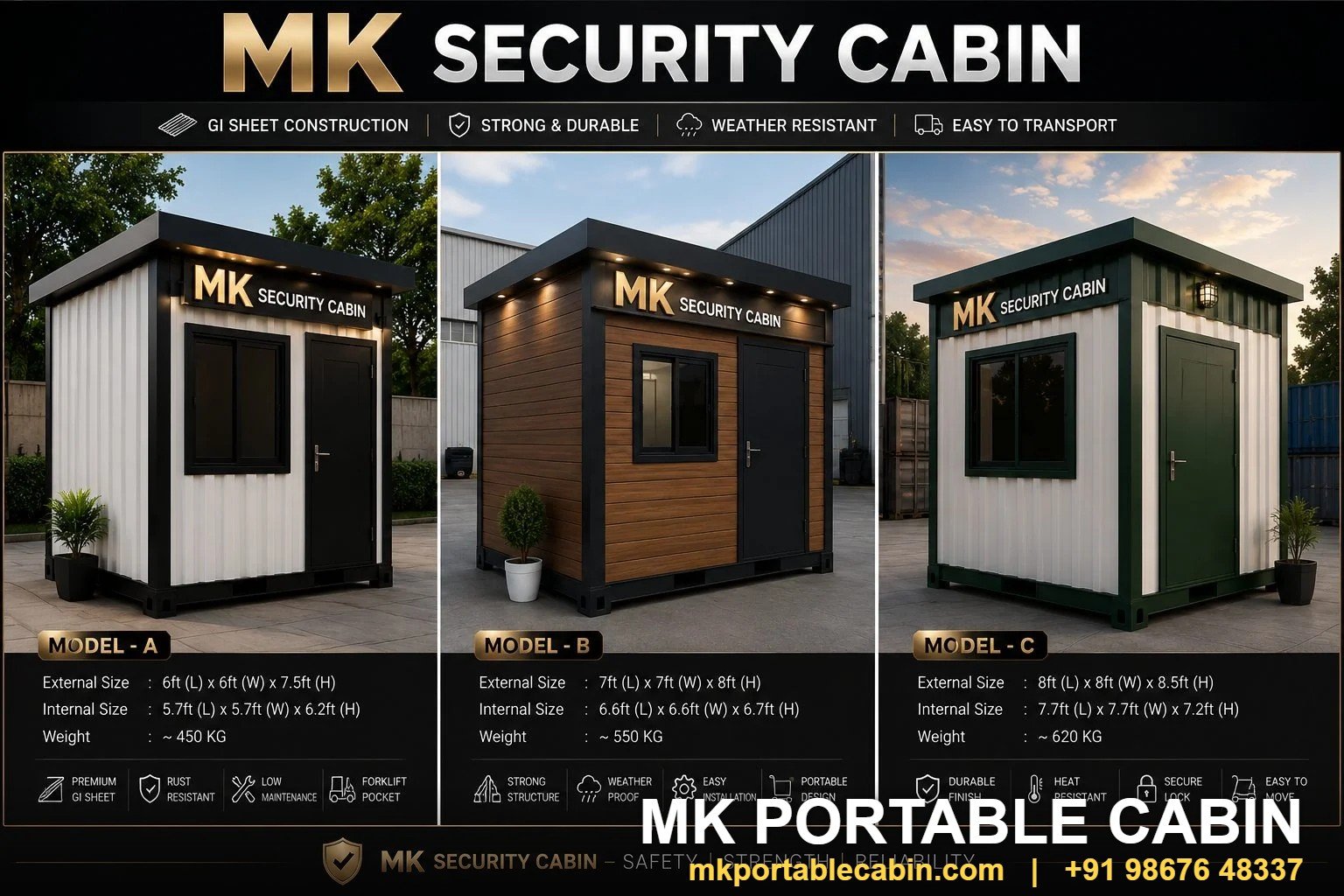
If you are buying a guard post for a site gate, a housing society entrance or a factory boundary, the first question is always the same: what decides the security guard cabin price? Two cabins that look identical in a photo can differ by a wide margin in cost, and the difference is almost never random. It comes from the panel, the frame, the size and the fittings inside.
This guide breaks down every factor that moves the price up or down, so you can compare quotes properly instead of picking the cheapest number on a sheet.
What decides the security guard cabin price
A guard cabin is a small structure, so small specification changes have a large effect on the final figure. These are the seven factors that matter most.
1. Size and footprint
Guard cabins are usually made in standard footprints — roughly 4×4 ft for a single standing guard, 5×5 ft or 6×4 ft for a seated guard with a small desk, and 8×6 ft or larger when a register table, a locker or a small toilet has to fit inside. Price scales with floor area, so decide the internal use first and then the size.
2. Wall panel type
This is the single biggest cost driver. Common options:
- PUF insulated sandwich panel — polyurethane foam core between two pre-coated steel sheets. Best heat and sound insulation, longest life, highest cost.
- EPS sandwich panel — thermocol core. Lighter and cheaper than PUF, less effective in high heat.
- Rock wool panel — used where fire rating matters, such as inside industrial plants.
- Plain GI / MS sheet with framing — the cheapest option, but it heats up quickly and needs a fan or AC to stay usable through a Mumbai summer.
3. Panel thickness
Panels are commonly supplied in 40 mm, 50 mm, 60 mm and 80 mm. A thicker panel costs more per square foot but keeps the inside noticeably cooler, which matters when a guard sits in it for a 12-hour shift.
4. Structural frame
A galvanised MS frame resists rust far better than a plain painted MS frame, especially in coastal cities and on sites with cement dust and water. The frame is hidden once the cabin is built, so it is the easiest place for a supplier to cut cost — always ask what has been quoted.
5. Flooring
Options run from a plain checkered steel floor to plywood with vinyl, to a full cement board and tile floor. Each step adds cost and adds life.
6. Doors, windows and visibility
A guard cabin lives or dies on visibility. Sliding windows on two or three sides, a glass front, a shutter for the collection window, grills, and a lockable door all add to the total. So does powder-coated aluminium joinery over basic steel.
7. Electricals and fittings
Wiring points, tube light, exhaust fan, ceiling fan, AC cut-out with support frame, a fold-down desk, a chair, a fire extinguisher bracket, a small rack — each is a line item. A cabin quoted “bare” and a cabin quoted “ready to use” are not comparable numbers.
Delivery, unloading and taxes
Two costs sit outside the cabin itself and are often missed when comparing quotes:
- Transport and unloading. Distance from the manufacturing unit, road access to the gate, and whether a crane or hydra is needed at site.
- GST. Check whether a quote is inclusive or exclusive — this alone can make a cheaper-looking quote the more expensive one.
Three specification levels, compared
| Item | Basic | Standard | Premium |
|---|---|---|---|
| Wall | GI sheet on frame | EPS / 50 mm PUF panel | 60–80 mm PUF panel |
| Frame | Painted MS | Galvanised MS | Galvanised MS, heavier section |
| Floor | Checkered steel | Ply + vinyl | Cement board + tile |
| Windows | One sliding window | Two sliding windows + grill | Glass front, three sides visibility |
| Electrical | One light point | Light, fan, 2 sockets | Full wiring, AC cut-out, exhaust |
| Best for | Short-term site use | Most site and society gates | Corporate gates, long deployment |
How to compare two quotes fairly
Before you compare the bottom line, make both quotes describe the same cabin. Ask every supplier for these eight details in writing:
- External size in feet, and internal clear size
- Wall panel type and thickness in mm
- Roof panel type and thickness
- Frame material and whether it is galvanised
- Flooring build-up
- Exact count of doors, windows and grills
- Electrical points included
- Whether transport, unloading and GST are included
Once those eight lines match, the price difference between two quotes is real. Until then, you are comparing two different products.
Buy or rent a security cabin?
If the cabin is needed for a project that ends in a few months, renting can make sense. If the gate is permanent — a society, a factory, a warehouse, a school — buying almost always works out cheaper across two to three years, and the cabin can be lifted and moved later if the layout changes. We covered this in detail in our buy vs rent cost comparison.
How long does a security guard cabin last?
A PUF panel cabin on a galvanised frame, kept painted and with its sealant checked once a year, comfortably runs a decade or more in Indian conditions. The things that shorten life are standing water at the base, a rusting untreated frame, and roof sealant that is never re-checked. Put the cabin on a small raised plinth or on channels rather than directly on soil, and most of that risk disappears.
Getting an accurate price for your site
Because so much depends on specification, an honest supplier will ask about your site before quoting a number. The details that let us price a guard cabin accurately are: the size you need, whether the guard will sit or stand, whether a toilet is required inside, the number of windows and which sides they face, the electrical fittings you want, and the delivery PIN code.
MK Portable Cabin manufactures security guard cabins, site office cabins, shop cabins, container cabins and portable toilets, and has delivered to 300+ clients across India. Send us your size and PIN code and we will send a written, itemised quotation you can compare line by line.
Request a quotation for your security guard cabin